Institute of Information Theory and Automation
The Czech Academy of Sciences
We conduct basic and applied research and educate in Artificial Intelligence, Signal and Image Processing, Systems Science and Applied Mathematics.


Artificial
Intelligence
Artificial Intelligence is a transformative field focused on developing algorithms and models that enable machines to perform tasks typically requiring human intelligence. We integrate AI into all research areas pursued within the Institute, specializing in machine learning, natural language processing, knowledge representation, econometrics, and computer vision.

Signal and Image Processing
Signal and Image Processing is a field that focuses on the analysis, transformation, and interpretation of signals and images to extract meaningful information. We are engaged namely in texture analysis, image restoration, blind deconvolution, superresolution, and video tracking, and we also transfer the developed algorithms to embedded devices.

System
Science
Systems Science is an interdisciplinary field that studies complex, dynamic and adaptive systems, their behavior, and the principles governing their structure, functioning, and evolution. It provides a holistic framework for understanding how different components within a system interact to produce the system's overall behavior.

Applied
Mathematics
Applied Mathematics is a huge field where mathematical methods are applied in various areas of human activity. We are involved namely in probability theory, applied statistics, data and analysis, calculus of variations, optimization theory, continuum mechanics, and econometrics.
News
FST4: ÚTIA releases a new generation of its Feature Selection Toolbox
31/10/2026FST4: ÚTIA releases a new generation of its Feature Selection Toolbox The Institute of Information Theory and Automation has published Feature Selection Toolbox 4, an open-source library and command-line tool that finds the best subset of a large set of candidates, now usable without writing any code and extended by a new stochastic search method for problems with tens of thousands of variables. The Institute of Information Theory and Automation of the Czech Academy of Sciences (ÚTIA) has released Feature Selection Toolbox 4 (FST4), the first new generation of its feature selection software since FST3 in 2010. Developed at ÚTIA since 1999, it now appears for the first time under a free software license, together with a new research paper. Feature selection answers a question that arises whenever data drive decisions: which of the many measured variables actually matter? The same question appears wherever a few items must be chosen out of thousands of candidates, from sensors to diagnos
Read moreCall for Applications: Director of UTIA CAS
19/10/2026The Czech Academy of Sciences invites applications for the position of Director of the Institute of Information Theory and Automation of the CAS (ÚTIA), with an anticipated term of office from 1 May 2027 to 30 April 2032. Applicants are expected to hold a university degree and scientific qualifications in a field relevant to the Institute’s research, have a corresponding research track record, demonstrate organisational skills and management experience, and have a good command of English. Application deadline: 18 November 2026 at 15:00 (CET). Full requirements, a list of required supporting documents, and application instructions are available in the Call for Applications (PDF).
Read moreÚTIA Study Accepted by a Leading Finance Journal
16/10/2026A new study by ÚTIA researchers Jozef Baruník and Matěj Nevrla has been accepted for publication in the Journal of Financial and Quantitative Analysis (JFQA), one of the leading international journals in financial economics. JFQA is one of only five finance journals included in the Financial Times FT50 list, which is used, among other purposes, to assess research quality at leading business schools. Publication is highly selective: the journal received 1,275 submissions in 2024 and accepted only around 6%. The paper, Common Idiosyncratic Quantile Factors and Asset Prices, examines the relationship between risks specific to individual companies and market-wide risk. It shows that risks that appear to be firm-specific contain a common component that becomes more pronounced during declines in stock returns. According to the study, stocks with greater exposure to this common risk earn a return premium of approximately 7–8% per year, even after accounting for established sources of financia
Read more11/5-6/2026 Discover the World of Science with ÚTIA at the Week of the Czech Academy of Sciences
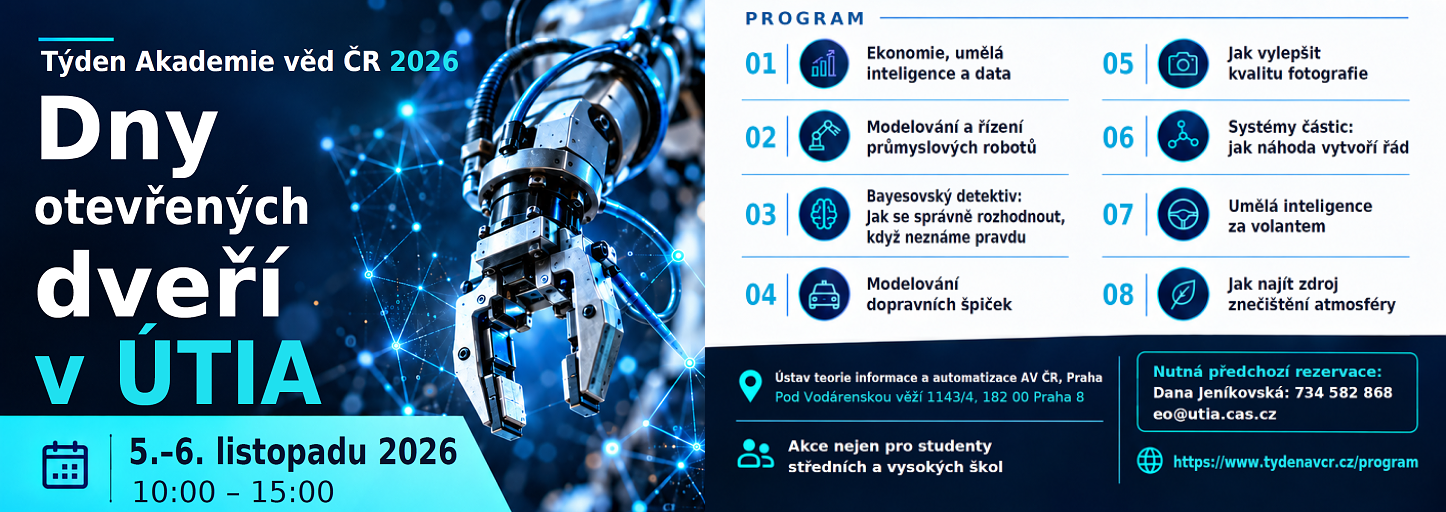
15/10/2026The Week of the Czech Academy of Sciences is just around the corner, bringing an opportunity to discover the world of science! From 2 to 8 November 2026, research institutes across the Czech Republic will open their doors to the public and offer a closer look at the work of scientists. ÚTIA will be taking part on Thursday 5 and Friday 6 November, with a series of lectures held in Czech. How can we identify the source of air pollution? How can we make the right decisions when we do not know the truth? And how can chance create order? These are just some of the questions we will explore together. The lectures cover a wide range of topics, including mathematical modelling, artificial intelligence, economics, image processing, robotics and other areas of ÚTIA’s research.
Read moreSpheroSeg: ÚTIA and UCT Prague develop a tool for analysing cell spheroids
01/10/2026A new publication in the journal Computer Methods and Programs in Biomedicine presents the results of a collaboration between researchers from the Institute of Information Theory and Automation of the Czech Academy of Sciences and the Faculty of Food and Biochemical Technology at the University of Chemistry and Technology, Prague. Together, they developed SpheroSeg, a platform using deep learning methods for the automated analysis of cell spheroids. Cell spheroids are three-dimensional clusters of cells used as models of tumour tissue, for example to study tumour growth or evaluate treatment response. Analysing them using microscopy images can be time-consuming, and the results can be affected by differences in the conditions under which the images were acquired. SpheroSeg can automatically identify and segment spheroids in bright-field microscopy images. Researchers can then manually adjust the results, obtain measurements of individual spheroid morphology, and export the data for fur
Read moreÚTIA Contributes to the New Czech Academy of Sciences Educational Trail
24/09/2026On Friday, September 25, 2026, a new educational trail will officially open on the grounds of the Czech Academy of Sciences in Prague 8. The trail presents the work of the institutes of the Czech Academy of Sciences based in this part of Prague. ÚTIA is contributing to the project with its own interactive exhibit – a Galton board. Designed as an “open-air science center”, the educational trail features seven interactive exhibits. They introduce visitors to a range of topics explored by the participating institutes and offer an opportunity to experience science directly in a public space. ÚTIA’s Galton Board ÚTIA’s exhibit is a Galton board, which provides a hands-on demonstration of basic principles of probability theory. As the balls pass through the board, they repeatedly change direction at random, gradually forming the characteristic shape of a normal distribution. The Galton board is based on a simple principle that makes it possible to observe how individual random events can pro
Read more





Welcome to UTIA
Let the director doc. RNDr. Jiřina Vejnarová, CSc.
give you a tour of the Institute (in Czech)
UTIA in the Strategy AV21
Hopes and risks of the digital age: prof. Ing. Jan Flusser, DrSc. presents a large-scale successful project, through which the Institute joined the AV21 Strategy programme (in Czech)